

This article is the seventh in a “What’s new, what’s next” series examining how B2B buying has quietly but fundamentally changed. Each piece explores a different pressure point in the modern buyer experience and how brand-led demand systems can reduce friction by enabling buyers to move forward on their own terms. The ideas stand alone, and they’re not meant to be read in order. Buyers don’t move that way anymore.
Revenue teams often ask a familiar question: Which buyer is showing intent?
That sounds reasonable, but it assumes a considered purchase only has one buyer. One person may sign the contract, yet a group shapes the decision. That group may be a formal buying committee or an informal mix of people with different priorities.
Operations study the business problem. A technical stakeholder reviews requirements. Someone in finance looks at the business case. Procurement checks risk. A member of the executive team wants proof that the company can deliver.
Most revenue systems record these actions as separate events tied to separate people. Each buying signal may look too small to matter, so the account pattern disappears among page views, content downloads and partial contact records.
Account-level intent data helps marketing and sales connect small individual behaviors across a group of self-directed buyers, then respond in a way that helps the group move forward.
Account-level intent is collective
Marketing qualified lead models usually evaluate one person at a time. They assign points to actions and alert sales when an individual crosses a threshold.
Complex purchases rarely work that neatly. Several people often share the research, and each person may explore only one part of the decision. One buying committee member reads an educational article. Another views a customer story. A third returns to an implementation page. Nobody looks like a strong lead alone, but the account may have moved from learning about a problem to comparing solutions.
The opposite can happen, too. One active contact may consume a large amount of content without an approved project, internal support or budget. The person looks ready, but the account may not be.
Account-level intent data helps marketing and sales bring behaviors from the same organization into one view. It doesn’t prove that an account plans to buy. It gives the revenue team better evidence.
Engagement means someone interacted with your company or content. Interest means the activity connects to a subject the account appears to care about. Intent means a wider pattern suggests that several people may be working through a business decision.
BrandDemand Marketing helps teams read the pattern in account-level buyer intent data
B2B buyer intent data can suggest that an account is moving. It can’t explain what each buyer believes, how the group sees your brand or what people still need before they can support a decision.
BrandDemand Marketing helps answer those questions by aligning brand building and demand generation with the needs of self-directed buyers.
Brand shapes how buyers interpret what they find. They want to know whether the company understands their problem, offers a credible point of view and feels different from other choices. Demand content helps each person answer questions tied to a role. Sales adds account knowledge. Customer experience brings proof about adoption and service. RevOps connects the signals.
An educational article may point to early problem research. Comparisons and customer stories may suggest active evaluation. Pricing, implementation and return content may show that committee members are reducing risk and building a case for action.
BrandDemand Marketing helps sales and marketing choose the right response. The account may need a clearer point of view, stronger proof, content for another buying role or a thoughtful sales conversation. It helps the group answer the questions standing between interest and action.
The BrandAction buyer signal map
BrandAction groups B2B buying signals into four categories.
- Behavioral signals show the subjects buyers are exploring. Article views, repeat visits and event activity can point to early interest. Marketing can respond with a clearer explanation of the issue and a distinct brand point of view.
- Readiness signals suggest that research has become more focused on a decision. Comparison content, pricing, customer proof and implementation material may indicate that buyers need more evidence. The BrandDemand response should reduce uncertainty and help buyers defend the decision.
- Account-level signals show that interest may reach several people or functions. Activity across roles and rising engagement can reveal the shape of a buying group. Marketing should support the different questions inside that group through one consistent brand story.
- Sales-validated signals connect digital behavior to a known business need. A project, leadership change, budget discussion or stated problem adds context that software can’t provide. Sales can then engage around the account’s real situation.
No signal tells the full story. A useful account view combines fit, breadth, depth, timing and human knowledge. BrandDemand Marketing connects that view to the content, proof and engagement buyers may need next.
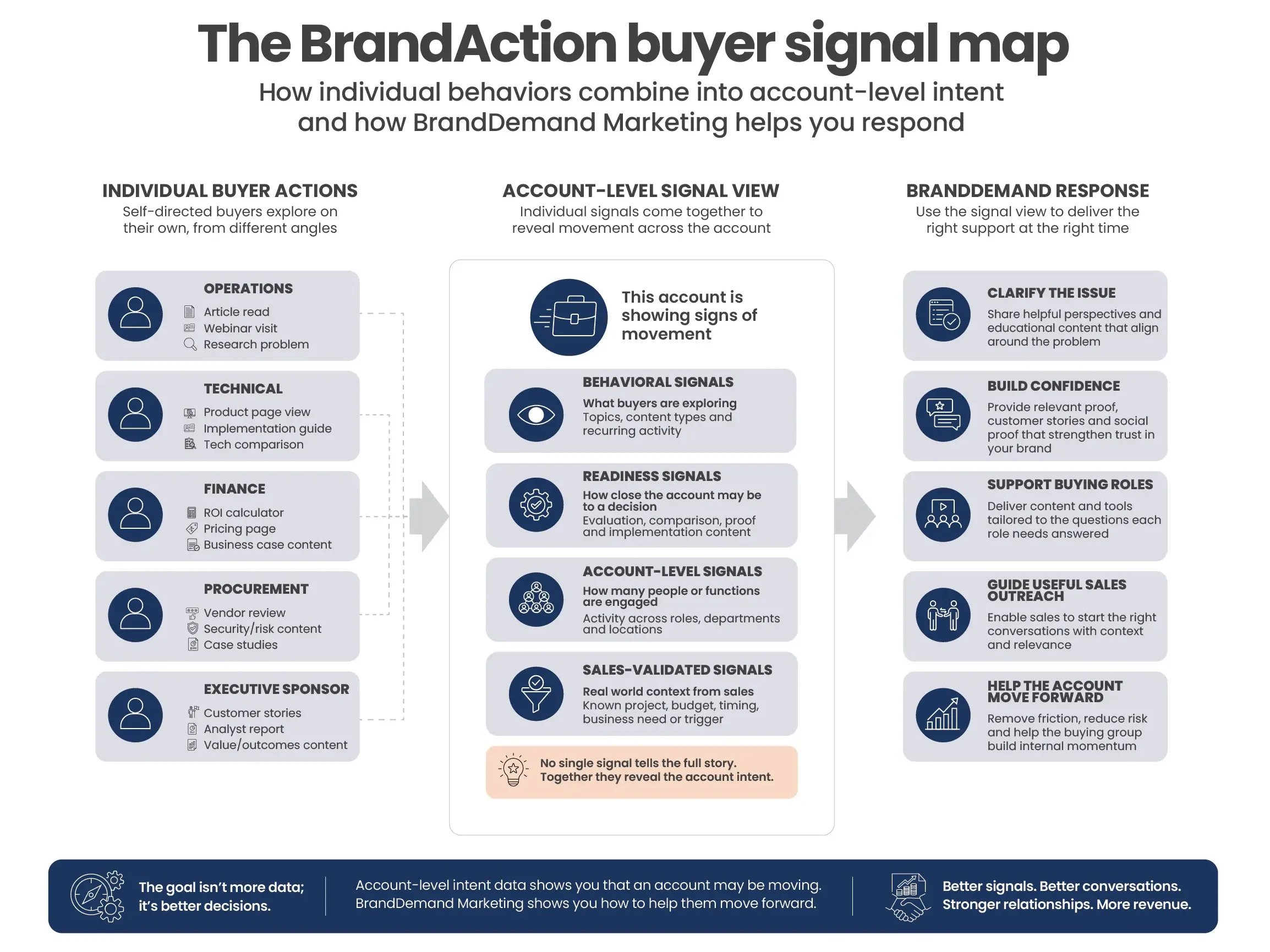
The BrandAction buyer signal map organizes available evidence according to what it may reveal and how sales and marketing should respond.
Five steps to see and support account movement
- Define the accounts and buying roles that matter
Marketing and sales should agree on which companies fit the business and which roles usually influence the purchase. Criteria may include industry, size, business need, revenue potential or strategic value.The goal isn’t to predict every committee member. It’s to understand the questions technical, operational, financial and executive buyers may bring to the decision. This view supports account-based marketing and key-account sales.
- Connect buyer questions to meaningful behaviors
The team should identify the questions buyers ask as they learn, compare, validate and decide. Marketing can then connect those questions to specific pages, assets, events and interactions.A customer story may show a need for proof. A comparison guide may suggest active evaluation. Implementation content may reveal concern about disruption, while an ROI calculator may help a champion make the financial case.
This work also shows where a content system can fall short. The team may have plenty of awareness content but little help for buyers who need to reduce risk, build agreement or defend the choice.
- Bring individual activity into a shared account record
RevOps or marketing operations should bring available first-party intent data into one company view. The record may include website activity, CRM history, marketing automation, events, advertising engagement and sales notes.Teams may also add third-party intent data from outside channels. The account view should show which subjects attract attention, which content buyers use, how many people or functions appear active and whether the pattern changes over time.
Teams don’t need to identify every anonymous person. They need enough perspective to recognize when several fragments may belong to the same decision.
- Judge the pattern, not the click count
A practical account model should consider fit, breadth across people or roles, depth of research, recency, rising activity and sales validation.Consider two accounts. One unknown person downloads five introductory articles. Three people from a target account view a customer story, implementation guide and pricing page. The first account generated more actions. The second may show a committee working through a decision.
Teams can start with low, moderate and strong classifications. Sales feedback can refine the model as the team learns which patterns lead to useful conversations and pipeline.
- Match the BrandDemand response to the evidence
Marketing and sales should agree on response rules before alerts arrive. Early account engagement may call for stronger brand visibility, related content or continued observation. Growing readiness may call for proof tailored to a role, comparison tools or customer evidence. Strong activity paired with sales knowledge may justify direct outreach.The response should address what buyers may need without revealing the tracking behind it. A seller shouldn’t say, “We noticed several people from your company visiting our website.”
A more helpful message might say, “Several companies in your industry are reassessing how they approach this issue. We recently created a guide that may help your team compare the available options and tradeoffs.”
Better signals should lead to better support, not faster spam.
Measure whether the account moves
Traditional campaign reporting focuses heavily on individual responses. Account-level measurements should show whether the right companies and buying roles move toward greater confidence and commercial action.
Useful measures include engaged account movement, activity across buying roles, use of proof and decision-support content, sales-accepted accounts, opportunities created and pipeline created. Teams should also track whether the brand earns visibility around priority subjects in search and AI-generated answers.
BrandDemand Marketing adds one more useful question: Did the company help the buying committee make progress?
The strongest view connects brand visibility, account engagement, sales judgment and pipeline. One person may eventually sign the contract, but the account builds the decision through the combined actions of several self-directed buyers.
Turn scattered buyer activity into a clearer account view
The BrandAction account signal playbook gives marketing, sales and RevOps leaders a practical framework for bringing together signals from multiple buyers, recognizing meaningful account movement and choosing the right response.
Technology can connect account-level intent data
Account-level intent platforms such as 6sense and Demandbase can help teams identify account activity and connect buying signals with sales and marketing work. Bombora provides third-party topic intent, while HubSpot Buyer Intent helps identify companies visiting a website and meeting selected intent criteria.
Those platforms can be helpful, but they aren’t the only way to get started. Smaller B2B firms can build a practical account tracking system with tools they may already have, including a CRM or email platform, Google Analytics 4, Google Tag Manager and first-party cookies.
Our Practical Guide to Account Signal Tracking explains how to assign anonymous visitor IDs, connect known email clicks and form activity to account records, bring earlier anonymous behavior into the account view and report on buying group movement without investing in a costly marketing platform.
Download the Guide to see how the system works and what you’ll need to build it.
Software can collect signals and connect records. Your team still needs to decide which buyer questions matter, what the account activity may mean and which BrandDemand Marketing response will offer the most help.
Didn't catch our previous articles?
No worries. Here you go:
Article 1: The real reason B2B buyers stopped responding
Article 2: Your funnel isn’t broken. It’s built for yesterday’s buyer.
Article 3: What’s new isn’t AI. It’s buyer-controlled discovery.
Article 4: Demand without desire is just noise
Article 5: Differentiated branding is the B2B buyers’ shortcut
Article 6: The real buying committee is invisible